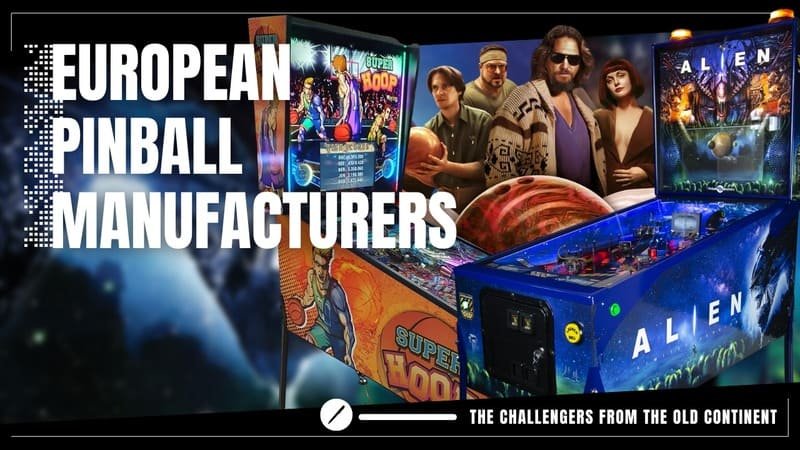
Historically, the pinball capital has always been Chicago. Nevertheless, Europeans also had a few manufacturers during the 80s and 90s, who all but disappeared with the collapse of bar and arcade operations. Over the past 10 years, as the market has revitalized itself with machines dedicated to home use, new players have once again tried their hand on the Old Continent.
Production quality varies greatly from one player to another, and volumes are well below those of the 2 American leaders, Stern Pinball and Jersey Jack Pinball. And we can’t say that there’s a European “touch” at this stage. Nevertheless, the initiatives are well worth the detour: here’s a look at the challengers from Europe.
Pinball Brothers, now Euro Pinball Corp.
Pinball Brothers (PB) rose from the ashes of another manufacturer: Heighwey Pinball, which disappeared in 2018. PB acquired the licenses and designs of its predecessor, and shared some of its investors.
On the other hand, Pinball Brothers’ HQ is based in Örebro, Sweden, whereas Heighwey Pinball founder Andrew Heighwey was based in the UK.
Pinball Brothers inherits two licenses, and not the least, and each is taken through to marketing and production:
- Alien, in standard and limited versions, released in December 2020
- Queen, in Champions Edition and Rhapsody Edition, released in 2022
The Alien pinball playfield is based on the one designed by Heighwey, with a few optimizations and rationalizations. The original machine was attractive, but the Pinball Brothers version takes nothing away from its charm.

On the Queen side, a prototype was exhibited in a London store dedicated to the band about a year before it went on sale. This sketch was also designed by Heighwey. Pinball Brothers makes it.

In view of the brand’s history, here are the questions that legitimately arise: what will Pinball Brothers’ future designs look like now that the Heighwey Pinball legacy has been exploited?
Let’s give them credit for one thing that sets them apart from market leader Stern Pinball: the different versions of the same pinball machine do not alter the gameplay in any way. Only the aesthetics vary. There are no cheap versions of the board, and all players benefit from the same gameplay experience. It’s a philosophy that we at Pinball Mag. appreciate.
In December 2022, PB announces its merger with Pedretti Gaming, which manufactures its machines. The alliance gave birth to Euro Pinball Corp. which is without doubt Europe’s biggest manufacturer.
In March 2024, Pinball Brothers releases its first pinball machine that is not inherited from the Heighway Pinball era: ABBA. In June 2025, the manufacturer announces Predator, based on the first films.
Dutch Pinball
Barry Driessen founded Dutch Pinball in 2010, which as its name suggests, is a Dutch company. In 2014, the manufacturer’s first feat of arms was the Bride of Pinbot 2.0 kit, a module for installation on the Bride of Pinbot pinball machine. The machine, originally released by Bally/Williams in 1991, is now equipped with a new code, a connected function for sharing scores online, a color screen…
This first attempt was not lacking in audacity, and production of the module continues to this day.
But Dutch Pinball has no intention of stopping there. In 2016, the manufacturer launched The Big Lebowski, a pinball machine based on the eponymous film. We couldn’t do better than refer you to the video on this game.
It is characterized by the richness of its playfield and a great respect for the treatment of the license. Even today, The Big Lebowski is a sought-after pinball machine, and each production run is eagerly awaited.
In May 2022, the company moves to Herkenbosch, still in the Netherlands, thus acquiring a larger workshop. This expansion allows Dutch Pinball to launch in 2024 a subsidiary named DPX (Dutch Pinball Exclusive). This “sister company” is intended to release pinball machines in limited quantities (maximum 500). The firm has filed patents in the United States indicating that it plans to revive titles that designer John Popadiuk never managed to produce in series (Alice in Wonderland, Retroatomic Zombie Adventureland, Magic Girl). Alice is the first to be marketed in October 2024, but will unfortunately be the only one, as strategic disagreements between the subsidiary and new investors lead to the closure of DPX.
Bitronic et Quetzal Pinball
Here’s a marriage of reason (for love, we’ll ask them) between Quetzal Pinball, which designs pinball machines, and Bitronic, which knows how to manufacture them.
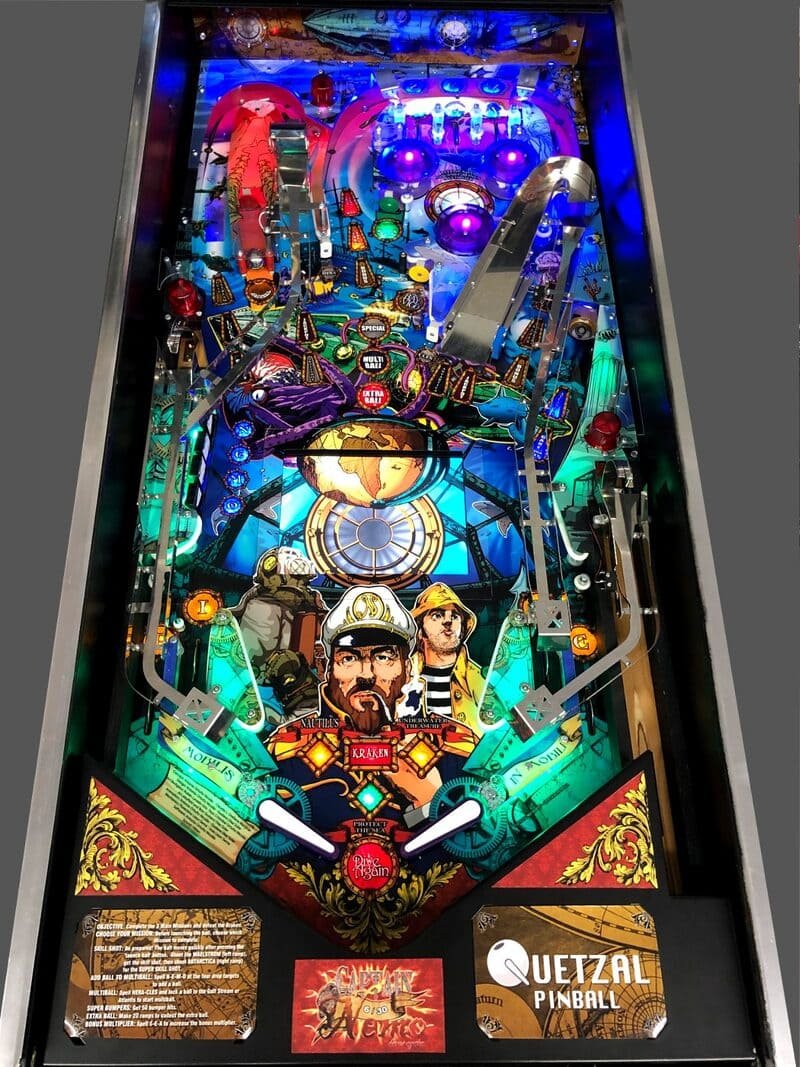
Quetzal started out with two small productions. Their first pinball machine was “Captain Nemo dives again”, announced in 2012 at 30 copies. This number had still not been reached by 2020.
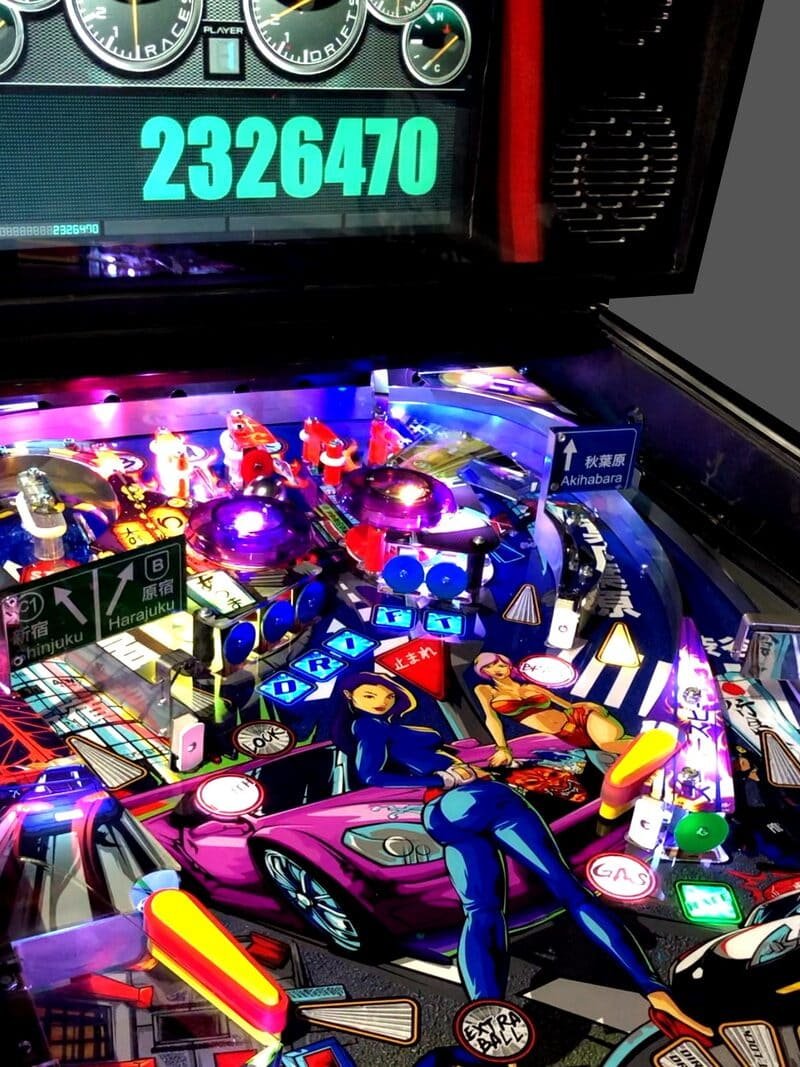
The second concept is “Tokyo perfect drift”, which is still in production. The concept was realized in 2018 and production started in 2019. The first model rolls off the assembly line in October 2019, with the rest leaving the workshop a priori in dribs and drabs.
It’s clear that Quetzal’s machines deserve a “maker”, i.e. a solid structure that allows Antonio Ortuño Nicolas and his Spanish team to give their ideas scope. This is now the case, thanks to the design team’s partnership with Bitronic. The latter has been building “recreational” coin-operated machines (arcade terminals, dart boards, etc.) for several years.
So Bitronic placed an order with Quetzal for a pinball machine adapted to the operation. The designers chose to reinvent a machine named Canasta 86, manufactured at the time by a Madrid-based manufacturer: Inder, an acronym for Industria Eclectromecanica de Recreativos. In addition to echoing an old glory of the Iberian peninsula, the basketball theme retains its relevance, as the sport remains very popular there.
As for adapting the game to operating conditions, the gamble was to avoid using drop targets, which would probably lead to frequent breakdowns.
Finally renamed (license problem?), the Super Hoop pinball machine was presented in January 2022 by its official importer in France: Planète Jeux Transcard.

The small pinball craftsmen
Once we’ve listed the 3 manufacturers above, we move down a notch in terms of company size and production volume. Here are two names that have yet to make it to the forefront. This paragraph focuses on players who have gone beyond the “Homebrew” stage (prototype for private use), otherwise the list would be loooonger.
Team Pinball
3 Heighwey Pinball ex-partners, living in Wales (UK), set up their company a few years ago. For over a year, they designed and built 10 copies of their first machine: The Mafia, officially announced in 2018. Unfortunately, 2 years later, the team hasn’t produced more than those first 10 games.
The Mafia is a pinball machine that cuts to the chase, with no ramps and a simple playfield, but rather elaborate artwork if you like the cartoonish side.

Don’t think the trio have stopped there: in 2021, they’re back designing the Rudy’s Nightmare kit. This is a sort of extension and modernization of the legendary FunHouse pinball machine, designed by Pat Lawlor. The kit is manufactured by Pedretti Pinball, an Italian company that holds the rights to spare parts and mods for Bally/Williams games.
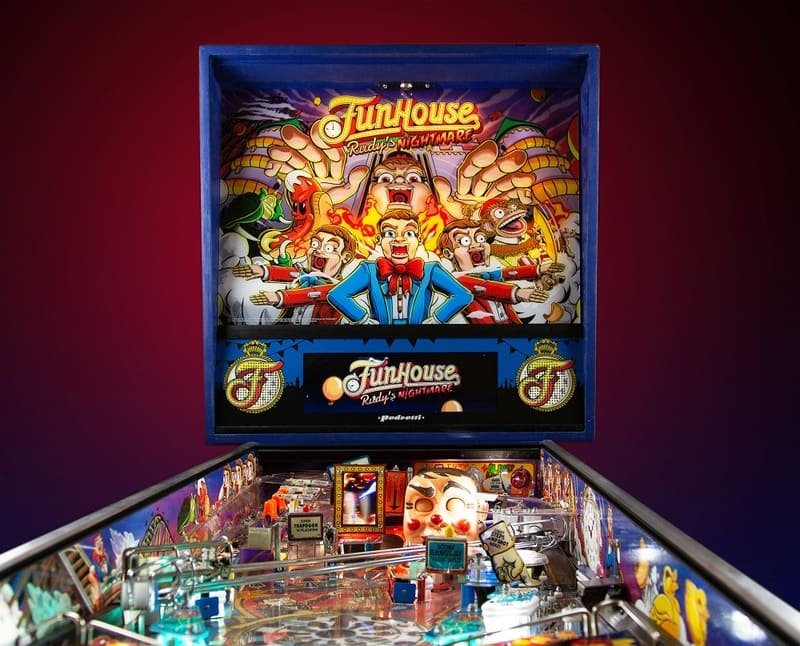
In an interview with Pinball News, the 3 partners Janos Kiss, Otilia Pasareti and Romain Fontaine point out that they have learned from Heighwey Pinball’s mistakes: they all have complementary jobs on the side, which allow them to take their time and succeed.Finally, Team Pinball has designed two pinball machines for Canadian manufacturer Pinball Adventures: Punny Factory and The Elements, due for release in 2023.
Hexa Pinball
The Hexa Pinball team, which as its name suggests is French, is based in Bordeaux. It released its first pinball machine in June 2023: Space Hunt. The aim is clear: to do things well, even if it means doing them simply. The playfield is sober overall, but tries to innovate on gameplay aspects.This first model is based on the homebrew of the same name, on which Luis Dos Santos, one of the team members, had been working for years. Romain Fontaine, already mentioned above at Team Pinball, is also part of the adventure.

Phénix Pinball
Olympic Goblin, finally renamed Goblin Contest when it went on sale in 2018 for legal reasons regarding the term “Olympic”, is Phénix Pinball’s first pinball machine. While founders Christian Petit and Julien Larose had lofty ambitions at the outset, it’s difficult to know the status of the project today. It seems that the duo make ends meet with restoration work.
Goblin Contest is a pinball machine that aims to be simple in its design and game mechanics.

Do European manufacturers have a future?
Problems of supply, distribution, compatibility with American standards… One might think that European manufacturers don’t have all the odds on their side. But there’s another way of looking at the situation.
Gary Stern told us in an interview that exports accounted for 35% to 40% of the market leader’s pinball sales, with Western Europe accounting for a major part of this percentage. The euro zone therefore represents a significant pool of potential buyers.
Within the European Union, the euro/dollar exchange rate and customs duties are a thing of the past. Without cutting into their margins, our manufacturers are mechanically competitive on the price side. Or they can generate more margin for an equivalent price. All they have to do (easy for us to say!) is increase their production rate and secure the quality of their machines, in terms of both design and reliability. Customers will follow, no doubt about it.